This is less about advice and more about what you like at table. Do you like loot and monsters being plentiful? More scarce hallway and corridor dungeons that stretch out and confuse the players? Is your dungeon little to no corridors at all and is a maze of rooms of unimaginable size and shape? Is it gonzo or grounded? What do you like?
I’m maybe kind of boring when it comes to planning dungeons. As a GM, I like to have the dungeons “make sense” (if that makes sense). I don’t care for most of the pre-generated map that are artistically designed and cool looking, but aren’t very “realistic.” Master villain got minions? They’ll need barracks. They’ll need larders. They’ll need support staff. Horses? Stables. Wyvern moints? Big stables with access to the sky. No weird mazes of oddly shaped rooms connected by illogical hallways. You can absolutely still fill places like this with great magic and intriguing stuff, but I think it benefits the players and the smoothness of the adventure to lay out dungeons in a way the players can anticipate.
2 Likes
Interesting! You plan it all out by 10x10 squares or do you prefer to keep it text but well defined? I’m a much more gonzo liking person who can’t draw a dungeon to save her life, no matter how much I study Janelle J. so I prefer to keep it text.
I’m more of a gonzo kind of guy, although I try to keep some internal coherence. I don’t bother too much with realism in terms of room functionalities, but once something is established in the campaign, I remain coherent to it in the following dungeons (e.g. in one of my campaigns, we established that Chaos cultists pray a lot, so every dungeon inhabitated by them always has a room set aside for worship, like a chapel).
I also love long corridors which connect multiple rooms.
1 Like
Oh thats a great way to do it. Do you map everything out? Seems like something that might be a pain to constantly remember to insert in the process.
Do you like loot and monsters being plentiful?
I stick to the stocking rules given in B/X. Roughly speaking 1/3rd of rooms being empty. This allows players to set the pace, breathe, re-group etc. Giving every room something, takes away from the whole of the dungeon, I believe.
1 Like
A more by the book style then? Personally do you like more interconnected rooms or do you not mind the mapping process and design and describe the dungeon for your players?
Yes, I find playing by the book to be providing a fine balance. So, unless I have a better idea to ignore that (something cool, something interesting, etc.) I stick to it.
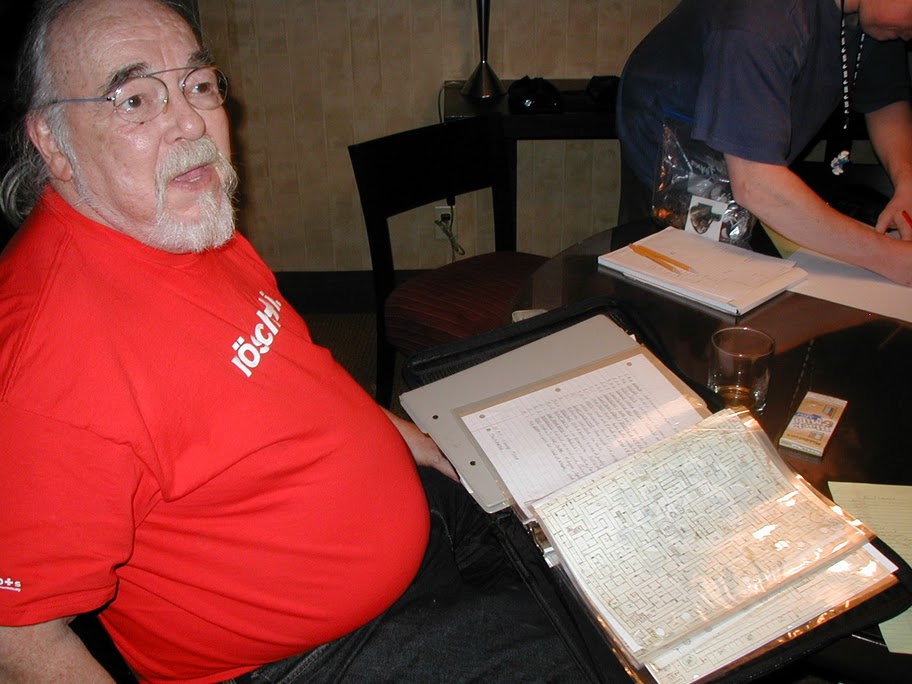
In terms of dungeon design, I prefer the old-school style where rooms are tightly woven and interconnected (here’s an extreme example of this by a guy called Gary).
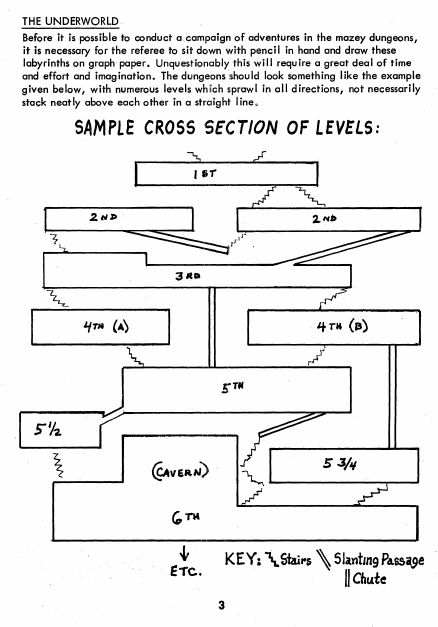
One topic I feel missing in OSR movement is the element of verticality in dungeon design. That’s the first thing you see in LBB with the example dungeon. But in OSR, it seems like all dungeons are just built upon flat plan with the floor permit limited to 1:
Another thing missing in OSR dungeons (and wilderness) is terrain. It feels like most dungeons are built upon flat plains with no elevation. This becomes more evident as you play more (historical) wargames; the importance of positioning, terrain features etc. The game is called dungeons AND dragons for a reason, I believe. If monsters is 50%, the other 50% is the environment. Yet it gets overlooked for some reason.
2 Likes
It’s funny, I prefer Gary’s tighter and more gonzo dungeons because I can’t plan dungeons to save my life and like to combine sources but I like Arneson’s more lightweight way of running but not so much his dungeons!
I completely understand the frustration for the terrain and it’s partially why I prefer O/NSR games over 5e. Having so many rules that would interact but very little as to what you can do to not break it’s precarious balance felt weird. Dungeons could make it harder to breathe, force you to squeeze into a gap that you couldn’t see to the end of due to how you had to fit in, change the landscape over night, or even gave you features you could use against your foes. It seems in newer editions its much more on the “what your unit can do to another unit” and feels more rank and flank to me than skirmish.
I generally run dungeons in a more horror fashion, always having fucked up things in them. I also like to use them as lore dump/exposition points without having to actually “say” any of it. The murals, the environment, leftover objects, etc. I also generally concieve of them in the first place as tombs or religious sites fallen to ruin before other kinds. I also generally prefer dungeons to be “pre loaded” ie no wandering monsters and such, everything is in it’s place, and the dungeon is only one level. They are more well defined boxes to be picked through than mythical hellpits. EDIT: Oh, I also love fucked up caves(Veins, Lowlife)
1 Like
I map everything out beforehand, I have terrible spatial sense and without a reference I make a mess of the map. When I don’t have the time or the energies to do everything from scratch I pick up a map and just change the rooms to fit what I want.
1 Like